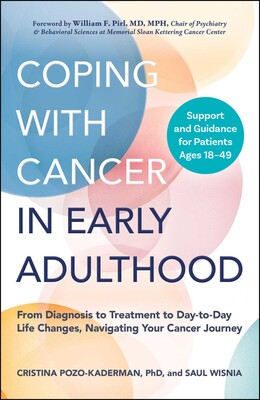
 Coping with Cancer in Early Adulthood: From Diagnosis to Treatment to Day-to-Day Life Changes, Navigating Your Cancer Journey
By Cristina Pozo-Kaderman, PhD, and Saul Wisnia
Review by Amy Colver, LISW, OSW-C
Several months ago, one of my AOSW colleagues reached out to let me know about a book that provides support and guidance to adolescents and young adults (AYAs) with cancer. Shortly thereafter, I connected with one of the authors, Dr. Pozo-Kaderman, to learn a bit more about the book, Coping with Cancer in Early Adulthood: From Diagnosis to Treatment to Day-to-Day Life Changes, Navigating Your Cancer Journey, that she recently published with her colleague, Saul Wisnia. As an AYA cancer survivor myself and an oncology social worker who is passionate about this population, I was delighted to make this connection. I took my time reading the book over the last few months and found myself writing this review from a place of gratitude, not only for the connection to Dr. Pozo-Kaderman and the opportunity to have read this incredible book, but also to share some highlights from my perspective.
The book starts with the authors thoughtfully outlining the issues unique to AYAs with cancer. From the factors that lead to delayed or missed diagnoses and the rise in new cases in this age group, to psychosocial issues and AYA patients feeling out of place in health care settings, the stage is set for all the content in the rest of the book.
Dr. Pozo-Kaderman grounds us in the reality that the period from age 18 to 49 is a time of growth, excitement, and challenges as people explore their identity and who they wish to become. And, when a cancer diagnosis happens within this time, it feels like a threat to their autonomy and the future.
There are a couple of things that I especially appreciated at the beginning of the book. First, Dr. Pozo-Kaderman suggests that people can use the book in whatever way works best for them; whether they read it from start to finish, jump around topics, take breaks, skim through sections, or spend more time on others. The recognition that sensitive, difficult topics are covered provides a sense of acknowledgment and understanding. People are also encouraged to discuss any concerns that arise while reading the book with their health care team, demonstrating additional consideration for readers.
The following chapter topics range from the early days of diagnosis, sharing the news, and next steps, to coping with treatment, emotional changes, well-being, mental health, sexual health, self-care, and living with purpose. There’s also a chapter about post-treatment life, and one on living with cancer as a chronic condition or one that has recurred or metastasized. There’s truly something for everyone impacted by AYA cancer, including patients, their loved ones, and health care providers.
Each chapter begins with a patient story, which, from my perspective, brings the content to life and helps people know they’re not alone in their experiences. There are also quotes throughout the book called “patient voices,” which I found to be comforting and inspiring. In certain sections of the book, Dr. Pozo-Kaderman also writes about common concerns she hears from patients regarding different aspects of the cancer experience, offering validation and consideration for what people may be experiencing.
The chapters are packed with thorough, practical information that covers every aspect of the cancer experience. There are so many examples that I could share, but a few things that stood out to me include:
- Questions patients can ask themselves to check in on how they’re doing and what’s important to them
- Questions for the health care team, including who the different providers are, and their roles
- Tips and suggestions for dealing with things like hair loss, nausea, chemo brain, and cancer-related fatigue during treatment and afterward
- Examples of helpful and unhelpful support, and dealing with toxic positivity
- How to stay in touch with friends, engage in self-care, implement effective coping strategies, and find professional as well as peer support
- Ways to deal with the “disruptions” that happen in life, such as school, work, a living situation, and more.
At the end of each chapter, there’s a summary of key points, and the book concludes with a resource list, covering every aspect of support, assistance, or information that a person may need.
Overall, the themes that were present for me throughout the book are self-kindness, self-advocacy, and empowerment. I appreciate the thoroughness of the content and the way Dr. Pozo-Kaderman guides people through each step of the journey. I could see how any AYA with cancer, but especially someone who feels alone, unsure, or overwhelmed about what to do would find support, validation, and reliable, thorough information that’s delivered in a practical manner. When I was diagnosed over 20 years ago, the AYA field was in its very early stages. I’m grateful for all the advances made in the field, while also acknowledging that there’s still work to be done. While we all work to support the AYA population, I’m also grateful that the book, Coping with Cancer in Early Adulthood: From Diagnosis to Treatment to Day-to-Day Life Changes, Navigating Your Cancer Journey, exists, as I believe it will help young adults from a variety of backgrounds move through their diagnosis in ways that are personalized and unique to them.